Most F&B Operations Do Not Have a Revenue Problem. They Have a Structure Problem.
In hospitality, Food & Beverage performance is often evaluated through revenue.
More covers.
More guests.
More sales.
More occupancy.
And while these metrics certainly matter, they can also create a dangerous illusion.
Because revenue alone does not guarantee profitability.
In fact, many hospitality businesses generate significant revenue every day while continuing to struggle with margins, operational consistency, and financial predictability.
The reason is simple.
Revenue can be generated.
Profitability must be engineered.
The challenge is rarely attracting guests.
The challenge is building an operational structure capable of converting revenue into predictable profit.
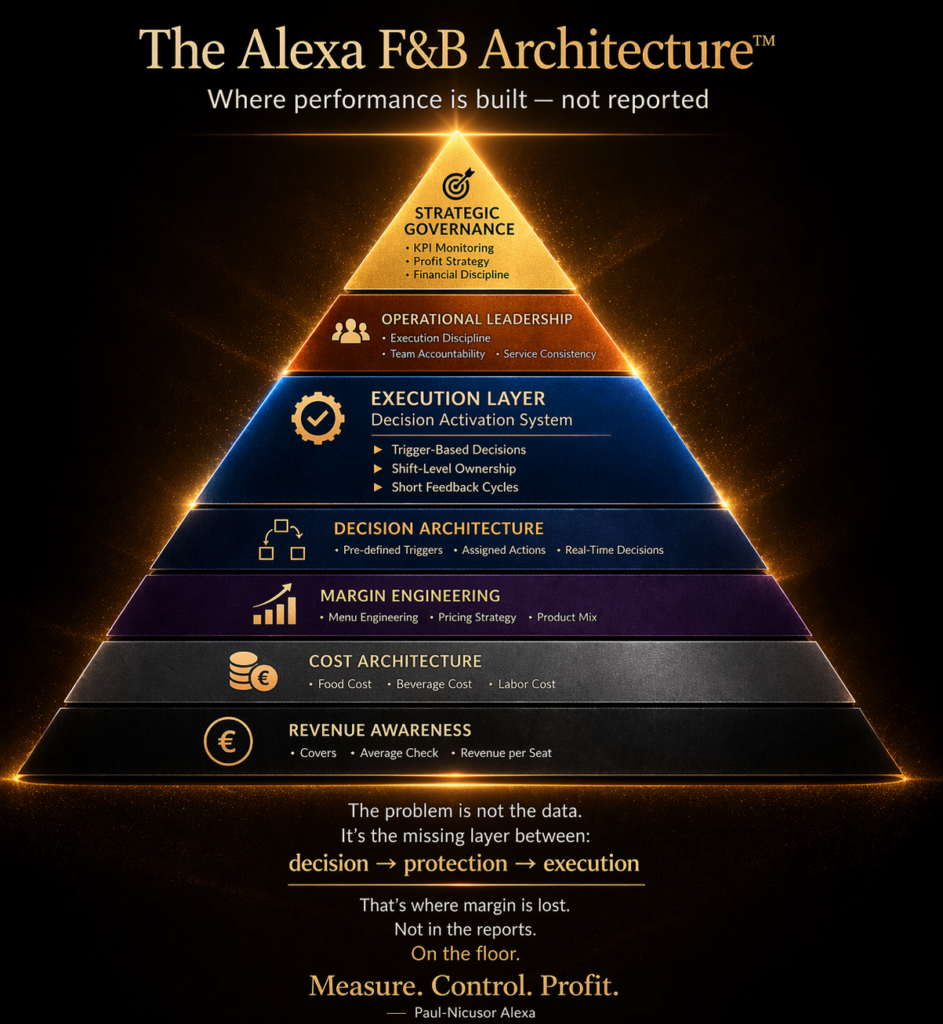
A structured framework designed to connect decisions, execution, accountability, and profitability across hospitality operations.
The Financial Results Are Usually The Last Thing To Change
When profitability declines, most organizations immediately focus on financial reporting.
Food Cost.
Labor Cost.
Prime Cost.
Monthly P&L reviews.
Variance reports.
These tools are important.
But they only describe outcomes.
They do not create them.
By the time a negative trend appears in a report, the operational behaviors that caused it have often been happening for weeks or months.
This is why profitability is rarely lost inside the numbers.
It is lost inside execution.
Long before the numbers appear.
Long before the report is generated.
Long before management notices the trend.
The financial report simply reveals what operational decisions have already produced.
Margin Is Lost One Decision At A Time
Most hospitality businesses do not lose profitability through one catastrophic mistake.
They lose it through hundreds of small decisions repeated every day.
A missed beverage recommendation.
An unnecessary discount.
A poorly managed reservation.
An oversized portion.
A stock variance ignored.
A menu item positioned incorrectly.
A service priority misunderstood.
Individually, these decisions appear insignificant.
Collectively, they determine the economic performance of the operation.
This is where many organizations underestimate the true source of financial leakage.
Because profitability rarely disappears through a major event.
It disappears through operational friction.
One decision at a time.
One service at a time.
One shift at a time.
The Real Test Begins When Pressure Arrives
Every operation performs reasonably well when conditions are ideal.
The true test begins when pressure arrives.
The restaurant becomes full.
The kitchen is under stress.
Multiple requests arrive simultaneously.
The pace accelerates.
Time becomes limited.
At that moment, nobody opens a report.
Nobody analyzes a dashboard.
Nobody studies the P&L.
People execute.
And under pressure, people rarely optimize.
They execute what the system has already made clear.
This is one of the most important realities in hospitality management.
Performance under pressure is not created during pressure.
It is created before pressure arrives.
If priorities are unclear, execution becomes inconsistent.
If ownership is unclear, accountability disappears.
If profitability depends on individual heroics, performance becomes unpredictable.
The strongest operations are not the ones with the most talented individuals.
They are the ones with the clearest operational architecture.
Why Visibility Does Not Automatically Create Control
Many organizations invest heavily in reporting systems.
Dashboards.
KPIs.
Business intelligence tools.
Data collection.
Visibility is important.
But visibility is not control.
A dashboard can identify a problem.
It cannot solve it.
A report can reveal a trend.
It cannot execute a decision.
The critical question is not whether the organization can see the problem.
The critical question is what happens after the problem becomes visible.
Who owns the response?
What action is required?
How quickly must it happen?
What prevents delay?
What protects execution during service pressure?
Without these answers, reporting becomes observation rather than management.
Because information alone does not create performance.
Execution does.
Why SOPs Alone Rarely Solve The Problem
When consistency declines, many organizations respond by creating additional SOPs.
Unfortunately, more SOPs rarely solve execution problems.
An SOP is a reference.
It defines what should happen.
It does not guarantee that it will happen.
The real operating system of an F&B business consists of much more than documented procedures.
It includes:
• Leadership discipline
• Accountability structures
• Operational ownership
• Training systems
• Reinforcement mechanisms
• Decision triggers
• Performance reviews
• Protected priorities
The SOP defines the standard.
The system determines whether the standard survives under pressure.
The gap between those two realities is where many organizations lose control.
Revenue Can Be Generated. Margin Must Be Protected.
One of the most overlooked realities in hospitality is that revenue and profitability are fundamentally different challenges.
Revenue generation is often visible.
Marketing campaigns.
Promotions.
Occupancy growth.
Increased traffic.
Additional covers.
Profitability behaves differently.
Profitability depends on protection.
It depends on thousands of operational decisions that preserve contribution margin throughout the guest journey.
A restaurant can increase revenue while simultaneously reducing profitability.
A hotel can increase occupancy while reducing operational efficiency.
Growth without structure often creates complexity.
Complexity without control often destroys margin.
This is why successful operators focus not only on generating revenue.
They focus on protecting it.
Because revenue enters through the front door.
Margin often leaves unnoticed through the back.
The Missing Layer: Decision Architecture
Most organizations already possess information.
Most possess capable teams.
Most possess operating procedures.
What many lack is a structure capable of transforming information into consistent action.
This is where Decision Architecture becomes essential.
Decision Architecture defines:
• What decisions matter
• Who owns those decisions
• When they must occur
• Which priorities are protected
• Which trade-offs are acceptable
• Which actions are triggered automatically
The objective is not complexity.
The objective is clarity.
Because during peak service there is no time to interpret.
There is only time to execute.
The strongest operations do not depend on improvisation.
They depend on decisions that have already been made.
Building Predictable Profitability
Predictable profitability is not a financial event.
It is an operational outcome.
It emerges from structure.
From discipline.
From ownership.
From execution consistency.
From leadership capable of connecting decisions to performance.
The most successful hospitality businesses understand that profitability is not created at the end of the month when reports are reviewed.
Profitability is created every day.
Every shift.
Every service.
Every operational decision.
Because in the end, most Food & Beverage operations do not have a revenue problem.
They have a structure problem.
And structure is what transforms revenue into predictable profit.
The Alexa F&B Architecture™
The Alexa F&B Architecture™ is a structured framework designed to connect decisions, execution, accountability, and profitability across hospitality operations.
It was built around a simple principle:
Performance is not created by reports.
Performance is created by the decisions that hold when pressure arrives.
Because sustainable profitability is never accidental.
It is designed.
It is protected.
And it is executed.
Where Performance Is Built — Not Reported.
— Paul Alexa
Food & Beverage Director | Performance Architecture & Profit Optimization