Most F&B operations don’t have a data problem.
In today’s fast-paced F&B industry, understanding data is crucial. For instance, operators should analyze customer preferences to adjust menus accordingly, which can lead to increased satisfaction and sales.
They have a decision problem.
Consider the integration of data from various systems: POS systems provide insights into sales patterns, while reports reveal trends over time. The synergy of data sources can lead to more informed decisions.
Every system today provides data:
- POS
- Reports
- Dashboards
- KPIs
Yet performance remains inconsistent.
Because the real gap is here:
data → decision → execution
Performance metrics must be evaluated regularly. For instance, weekly reviews of KPIs can highlight areas needing immediate attention, allowing for quick adjustments to operational strategies.
When pressure hits, teams don’t optimize.
They compensate.
- pushing volume instead of protecting margin
- reacting instead of deciding
- executing without direction
In high-pressure situations, it’s essential to have predefined responses. For example, if food costs rise unexpectedly, having a decision framework allows teams to react swiftly to maintain margins.
And that’s where profit disappears.
Not in the reports.
On the floor.
This is the missing layer most operations never build.
The Alexa F&B Architecture™ is a structured decision system designed to:
- translate data into real-time decisions
- remove dependency on individual judgment
- protect margin during service
It builds decision consistency under pressure.
THE ALEXA F&B ARCHITECTURE™
Implementing the Alexa F&B Architecture™ can transform operations. For instance, a restaurant that struggled with inconsistent revenue can find stability by adopting this structured approach.
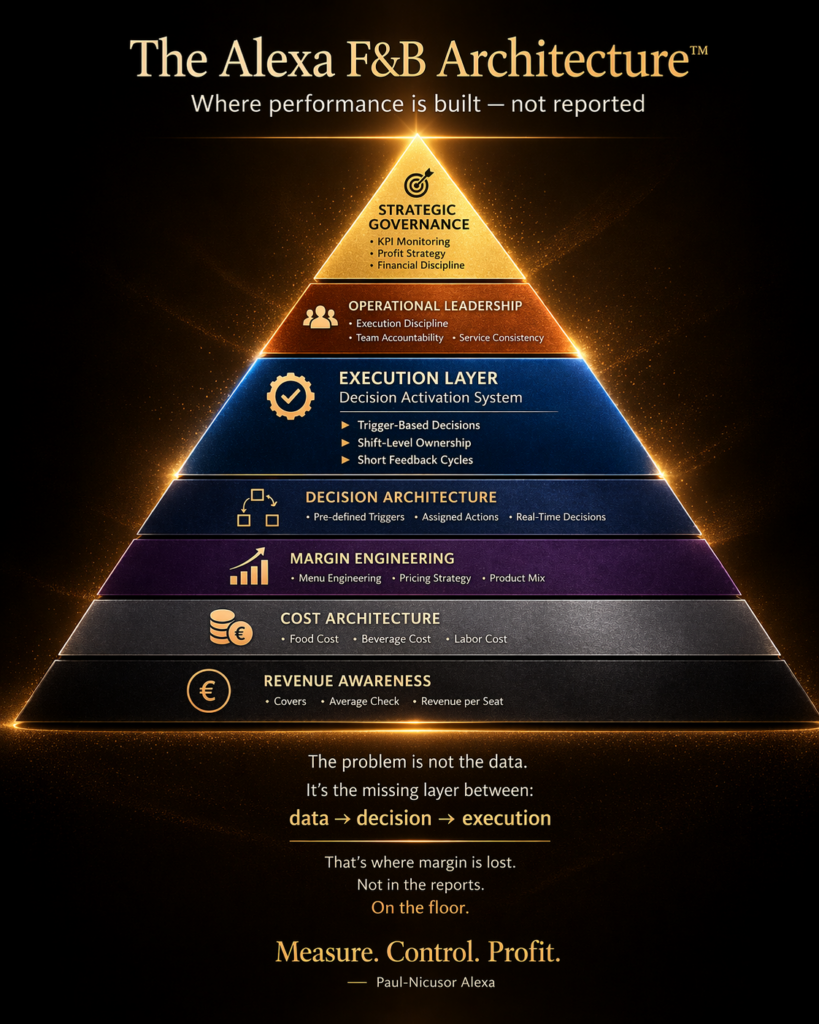
The system is not a concept.
It is a structured architecture built across 7 layers.
Each layer has a specific role.
Together, they turn operations into predictable performance.
This is the complete operational breakdown of the Alexa F&B Architecture™
THE 7 LAYERS OF THE ALEXA F&B ARCHITECTURE™
1️⃣ REVENUE AWARENESS
At the base of every operation:
Revenue must be visible, understood, and measurable.
Most operations track volume.
Few understand revenue dynamics.
This layer focuses on:
Each of the 7 layers plays a vital role in ensuring operations run smoothly. For example, a restaurant’s decision architecture may include staff training programs that enhance service delivery.
Revenue awareness helps operators identify peak times and adjust staffing accordingly, maximizing efficiency and customer satisfaction.
• covers
• average check
• revenue per seat
Without revenue awareness,
decisions are made blindly.
2️⃣ COST ARCHITECTURE
Cost is not something to “check at the end of the month.”
It must be structured and controlled.
Without a clear understanding of revenue dynamics, operators risk making uninformed decisions that could negatively affect their bottom line.
This layer defines:
Cost architecture should also factor in market fluctuations, allowing for proactive adjustments to pricing strategies that reflect current costs.
Cost structure informs operators on where savings can be made without compromising quality, such as sourcing ingredients locally or adjusting supplier contracts.
• food cost
• beverage cost
• labor cost
Not as percentages on a report,
but as real operational constraints.
3️⃣ MARGIN ENGINEERING
Revenue and cost alone don’t create profit.
Understanding margin engineering can lead to innovative menu items that not only attract customers but also yield higher profit margins.
Margin is designed.
This layer focuses on:
• menu engineering
• pricing strategy
• product mix
The goal is simple:
👉 maximize contribution per cover
👉 not just reduce cost
4️⃣ DECISION ARCHITECTURE
Decision architecture ensures everyone knows their roles. For instance, if a manager is responsible for adjusting pricing based on supply, the staff must understand this change and its implications.
This is where most operations fail.
Data exists.
But decisions are not defined.
This layer builds:
• predefined triggers
• assigned actions
• clear ownership
So that:
👉 decisions are not improvised
👉 they are executed consistently
Execution is where the theory meets practice. For example, staff should be trained to implement decision changes seamlessly, ensuring a smooth transition and maintaining service quality.
5️⃣ EXECUTION LAYER
A system only works if it activates behavior.
This layer translates decisions into action during service.
It includes:
• trigger-based decisions
• shift-level ownership
• short feedback cycles
The role of leadership is critical, as it fosters a culture where team members feel empowered to uphold system standards and continuously seek improvement.
This is where performance becomes operational.
6️⃣ OPERATIONAL LEADERSHIP
Without leadership, systems collapse.
This layer ensures:
Strategic governance involves regular assessments of KPIs to ensure that the operational strategy aligns with long-term goals.
• execution discipline
• team accountability
• service consistency
It connects structure with people.
7️⃣ STRATEGIC GOVERNANCE
At the top:
Ultimately, it’s about creating a cycle of continuous improvement, where data-driven decisions lead to consistent execution and, as a result, improved profitability.
Control, monitoring, and direction.
This layer defines:
• KPI monitoring
• profit strategy
• financial discipline
Integrating feedback loops in the system enhances adaptability, allowing teams to pivot when unexpected challenges arise.
It ensures that the system remains aligned over time.
⸻
HOW THE LAYERS WORK TOGETHER
Each layer depends on the one below.
You cannot fix execution
if decisions are unclear.
You cannot improve margin
if cost and revenue are not structured.
👉 Performance is not created in one layer.
👉 It is built across the entire system.
With a structured decision architecture:
- teams don’t react — they decide
- margin is protected during service
- performance becomes predictable
This is not:
- more reporting
- another SOP manual
- a dashboard
This is for:
- Hotels with high-volume F&B operations
- Restaurants with inconsistent performance
- Operators who want to move from reporting to execution
If you want to move from reporting to real performance,
this is where it starts.
The next step is simple:
Measure. Control. Profit.
By committing to this structured approach, operators can create a robust framework that can withstand the pressures of the F&B industry.
Table of Contents
— Paul-Nicusor Alexa