Better decisions.
Stronger operations.
Protected margins.
I provide hospitality consulting to help owners and leaders connect operational performance with clear decision ownership, practical authority and consistent execution.
Grounded in more than three decades of hospitality experience. Built for the moments when service pressure tests the plan.
to an accountable decision.
The report shows
the result.
Look at the decisions
behind it.
Demand, pricing and costs all matter. So does what happens between recognising a problem and having the authority to resolve it.
These are the operational situations where I focus the conversation.
Revenue grows. Margin remains uncertain.
Assess the mix, labour requirements and service commitments behind the revenue—not just the total.
The team keeps rescuing the same problem.
Repeated recoveries can conceal extra work, emergency purchasing and decisions that never get resolved.
Everything waits for one person.
Examine which decisions need senior involvement and where a clear local mandate could keep operations moving.
The promise arrives before the operational check.
Connect commercial commitments with capacity, service standards and the people accountable for delivery.
Hospitality consulting.
Decisions that work in practice.
My hospitality consulting uses Decision Architecture™ to examine how decisions are made, governed, executed and improved. The starting point is a real operational situation.
Understand
the situation
Establish what happened, which signals were available and what the operational consequences were.
Trace the
decision
Identify the owner, available authority, handovers and points where approval or information stalled.
Define the
conditions
Clarify responsibilities, decision limits, escalation timing and the resources required for execution.
Review what
changes
Agree what evidence to observe when the situation recurs and use the outcome to refine the next decision.
Operational experience.
A financial perspective.
My hospitality consulting brings together restaurant, bar, cellar and service operations with menu engineering, labour planning and performance control.
That perspective informs how I examine recurring exceptions, the cost of recovery and the decisions behind operating results.
Explore the performance case study →Four-star hotel
Food & Beverage operations
Connected operational responsibility
Daily coordination under pressure
Menu, mix and purchasing decisions
Planning, standards and execution
Performance measured.
Decisions made actionable.
Selected results from hospitality F&B management experience. Figures refer to specific operating initiatives, not guaranteed client outcomes.
Contribution per cover
Ancillary spend per guest
Beverage margin improvement
Operational waste
Historical management figures; measurement periods and baselines vary by initiative. Explore the case study for operating context.
Bring one performance problem.
Give it a clearer decision path.
Start your hospitality consulting enquiry with a recurring issue in your Food & Beverage operation. An initial written exchange helps establish the context and whether a focused review is appropriate.
Food & Beverage
Performance Review
A focused discussion of where performance may be lost between information, decisions and execution.
- Describe the issue and its operational impact.
- Identify the people, information and decisions involved.
- Agree the scope, evidence and expected outputs before an engagement begins.
The economics.
The authority.
The execution.
- Sales mix, pricing and contribution
- Food, beverage and labour performance
- Service commitments and operating capacity
- Decision ownership and escalation
- Recurring exceptions and recovery costs
The scope depends on the operation and available evidence. Objectives and deliverables are agreed in advance.
Paul-Nicusor Alexa
Food & Beverage Director · Founder of Decision Architecture™ · Strategic Advisor
More than three decades in hospitality have shaped my focus on the relationship between financial discipline, team leadership and decisions made during service.
I developed Decision Architecture™ to examine how organisations turn operational signals into accountable action—and how that action improves the next decision.
View executive profile →Hospitality consulting.
Your questions answered.
A closer look at performance, decision ownership and the practical starting point for a focused review.
What is hospitality consulting?
Hospitality consulting helps owners and leaders examine how an operation performs and decide what should change. In Food & Beverage, the starting point can be a margin concern, an unreliable handover, a recurring service exception or a commercial promise that creates unexpected work. The useful question is specific: which decisions influence the result, and what evidence would help the team make those decisions more consistently?
My approach connects financial discipline with the practical conditions of service. Revenue, purchasing, labour and guest expectations belong in the same conversation, because improving one measure can create pressure elsewhere. A lower purchasing price, for example, is not automatically a saving if preparation time, waste or service failures rise.
Hospitality consulting should make the decision clearer and its consequences easier to observe. It begins with an operating situation and an agreed scope, then examines ownership, authority, resources and follow-through. Recommendations need to fit the operation that will carry them out.
When is a focused operational review useful?
A review is worth considering when a problem returns despite repeated effort to solve it. The team may recover successfully each time, but the same recovery can consume management attention, overtime, emergency purchases or goodwill. Looking only at the final result can hide that cost and leave the underlying decision unchanged.
Start with one recent example. Describe what happened, what the team expected, who noticed the difference and how the response unfolded. Identify the immediate impact without assuming that the first explanation is the whole cause. A stock shortage, for instance, may involve ordering, forecasting, storage, communication or the authority to adjust a commitment.
Hospitality consulting provides a structured way to examine those connections. It does not require every issue to become a large transformation programme. A focused review can establish whether the problem is sufficiently defined, which information is missing and what kind of further work would be proportionate. The scope and expected outputs should be agreed before an engagement begins.
How does Decision Architecture™ support the work?
Decision Architecture™ examines how an operational signal becomes accountable action. A report may show that something has changed, but the report alone does not establish who must respond, what they can decide or when the response needs to happen. Those conditions influence whether a good intention becomes a reliable operating practice.
The framework follows four connected questions: what signal matters, who owns the decision, what conditions protect execution and what the outcome teaches the team. In practice, that can mean making decision limits explicit, clarifying an escalation point or checking that a handover contains the information needed by the next person.
Within my hospitality consulting approach, the framework keeps the financial result connected to the work behind it. It also provides a way to examine recurring dependence on individual judgement. The aim is to clarify responsibilities and review evidence, while allowing appropriate discretion when the situation requires it. The starting point remains a real operational example.
How can revenue rise while margins remain uncertain?
Higher revenue does not automatically mean that an operation retains more value. The additional sales may require a different product mix, more preparation, extra labour or a service commitment that uses scarce capacity. Discounts, complimentary items and recovery costs can also change the economics of apparently successful demand.
A useful review separates the sales total from the contribution and operating effort behind it. Consider which items or occasions generated the increase, how purchasing and labour changed, and whether waste or exceptions also increased. Comparisons need a consistent period and a clear baseline; otherwise a seasonal change can be mistaken for an improvement or deterioration.
Hospitality consulting can help frame these questions without treating a single percentage as the whole answer. The next step is to identify which decisions influence the pattern: pricing, menu mix, staffing, commitments or purchasing, for example. Any proposed change should be assessed alongside service standards and the team’s ability to deliver it consistently.
What should a Food & Beverage performance conversation cover?
A performance conversation should connect revenue, food and beverage costs, labour, waste and service delivery. Each measure provides part of the picture. Looking at them together helps distinguish a change in demand from a change in mix, resource requirements or execution. It also helps the team avoid improving one number at the expense of another.
The discussion needs enough operating context to make the figures meaningful. Which outlets, service periods and commercial commitments are included? What changed during the comparison period? Are the purchasing, sales and staffing figures aligned? What unusual events should be recorded before drawing conclusions?
In hospitality consulting, this context is as important as the calculation. An apparent variance may need a better explanation before it needs a corrective action. Once the evidence is understood, the conversation can identify a decision owner, a practical next step and an observation period. The purpose is to make performance information useful in the next operating decision, rather than simply adding another report.
How do menu, purchasing and labour decisions connect?
A menu choice affects more than selling price and ingredient cost. It can change preparation time, storage needs, purchasing flexibility, waste exposure and the demands placed on a service team. A popular item may be valuable, but its contribution should be considered alongside the work and capacity required to deliver it.
Purchasing decisions also interact with the menu and operating rhythm. A lower unit price can create a larger order, greater storage pressure or more spoilage. Labour decisions influence whether preparation and service remain reliable when demand changes. These relationships are best examined with the people who understand the work and the available evidence.
Hospitality consulting brings those decisions into a connected discussion. Rather than assuming that one department holds the answer, the review traces the consequences across the operation. A proposed change can then be checked against contribution, capacity and service requirements. The appropriate response depends on the situation; there is no single menu, purchasing or staffing formula that fits every operation.
What happens when too many decisions depend on one person?
Dependence on one person can slow an operation even when that person is experienced and committed. Information waits for attention, routine exceptions become escalations and the team may hesitate because the limits of its authority are unclear. Repeated interruptions can also make it harder for senior leaders to focus on decisions that genuinely require their involvement.
The first step is to distinguish between decisions that need senior approval and decisions that could sit closer to the work. Consider the consequences, the available information and the conditions under which escalation becomes necessary. Delegation needs a clear mandate and appropriate resources, as well as a shared understanding of the decision limits.
My hospitality consulting approach examines those conditions through actual examples. The aim is not to remove judgement or accountability. It is to make ownership explicit, establish appropriate authority and clarify what information must travel with a handover. Reviewing the outcome then helps the team refine the arrangement before the next similar situation.
How can teams reduce repeated service recovery?
Service recovery can protect the guest experience, but a successful rescue does not explain why the exception keeps returning. The immediate response may conceal additional labour, replacement stock, complimentary items or management time. Recording those consequences helps the operation see the full pattern rather than treating each incident as an isolated event.
Choose a recurring example and trace it backwards. What commitment was made? What information was available? When did the team recognise a mismatch between the promise and operating capacity? Who could change the plan, and what delayed that decision? These questions help separate the immediate symptom from the conditions that allow it to recur.
Hospitality consulting can support a more useful follow-up conversation by connecting the recovery with its decision path. A change might involve an earlier capacity check, a clearer handover or an agreed escalation threshold. Whatever the response, its effectiveness needs to be observed when the situation happens again. A new procedure alone is not evidence that the problem has been resolved.
What information is useful for an initial enquiry?
Begin with a short description of the situation you want to understand. Explain what happens, how often it happens, which part of the operation is affected and why it matters now. One concrete example is usually more useful than a broad statement that performance needs to improve. Include the practical impact on service, the team or financial results where you can describe it reliably.
An initial enquiry does not need to contain an entire operating history. It should help establish the question and whether a focused review is appropriate. Relevant reports, purchasing information, staffing context or decision records can be discussed once the purpose and scope are clearer. Avoid treating an incomplete number as a confirmed conclusion.
For hospitality consulting, the quality of the starting question helps determine the next step. A written exchange can identify missing context, clarify expectations and establish what evidence would be useful. Scope, responsibilities and expected outputs should be agreed before the engagement begins.
How are objectives and useful outputs defined?
Objectives should describe the decision or operating condition that needs to become clearer. “Improve performance” is a direction, but it does not define what the review should establish. A more useful objective might concern understanding a recurring margin variance, clarifying the authority behind an exception or identifying why a handover repeatedly delays action.
The expected output depends on the agreed scope and available evidence. It should help the people responsible understand the finding, assess its implications and determine a proportionate next step. Any limitations in the information need to remain visible, because a recommendation is only as reliable as the evidence and assumptions behind it.
Hospitality consulting also needs a clear distinction between a proposed action and an achieved result. An agreed next step should identify ownership, the conditions required for execution and the evidence to observe afterwards. That makes follow-up more practical and reduces the risk of treating a completed discussion as a completed operational improvement.
How should progress and historical results be interpreted?
Progress needs a defined baseline, a consistent measurement period and an understanding of what else changed. Revenue, contribution, waste and labour measures can move for different reasons. Demand, seasonality, product mix and operating commitments may affect the comparison, so a change in the headline number needs explanation before it is attributed to a particular action.
A useful review considers both results and execution. Was the agreed action carried out? Did the decision reach the right person at the right time? Were the necessary resources available? What happened when the situation returned? These observations help distinguish an unsuitable idea from an idea that was never fully implemented.
The historical figures shown on this page refer to specific management initiatives. They provide operating context and do not guarantee that another business will achieve the same outcome. Hospitality consulting should establish objectives and appropriate measures for the operation concerned, with assumptions and limitations made clear from the outset.
How do I choose the right starting point?
Choose the issue that is recurring, material and specific enough to examine. It may be tempting to begin with the largest ambition, but a concrete operating situation often provides a clearer route into the work. Consider what the issue costs the team, what decisions it involves and what evidence is already available.
The Performance Review page describes a practical starting point for this conversation. The case study provides additional operating context, while the executive profile explains the experience behind the approach. These resources can help you frame an enquiry around the situation that matters to your business.
You can begin by describing what keeps returning in your operation through the contact link below. The first written exchange helps establish context and whether a focused review is appropriate. Any engagement should have an agreed scope and next steps before work begins. The objective is a useful decision path that the operation can understand, carry out and review.
Practice, research
and continued inquiry.
Hospitality consulting starts with the realities of your operation. Explore the thinking behind decision ownership, service execution and financial discipline.

Decision Architecture™
The discipline behind decision ownership, authority, execution and organisational learning.
Explore the discipline →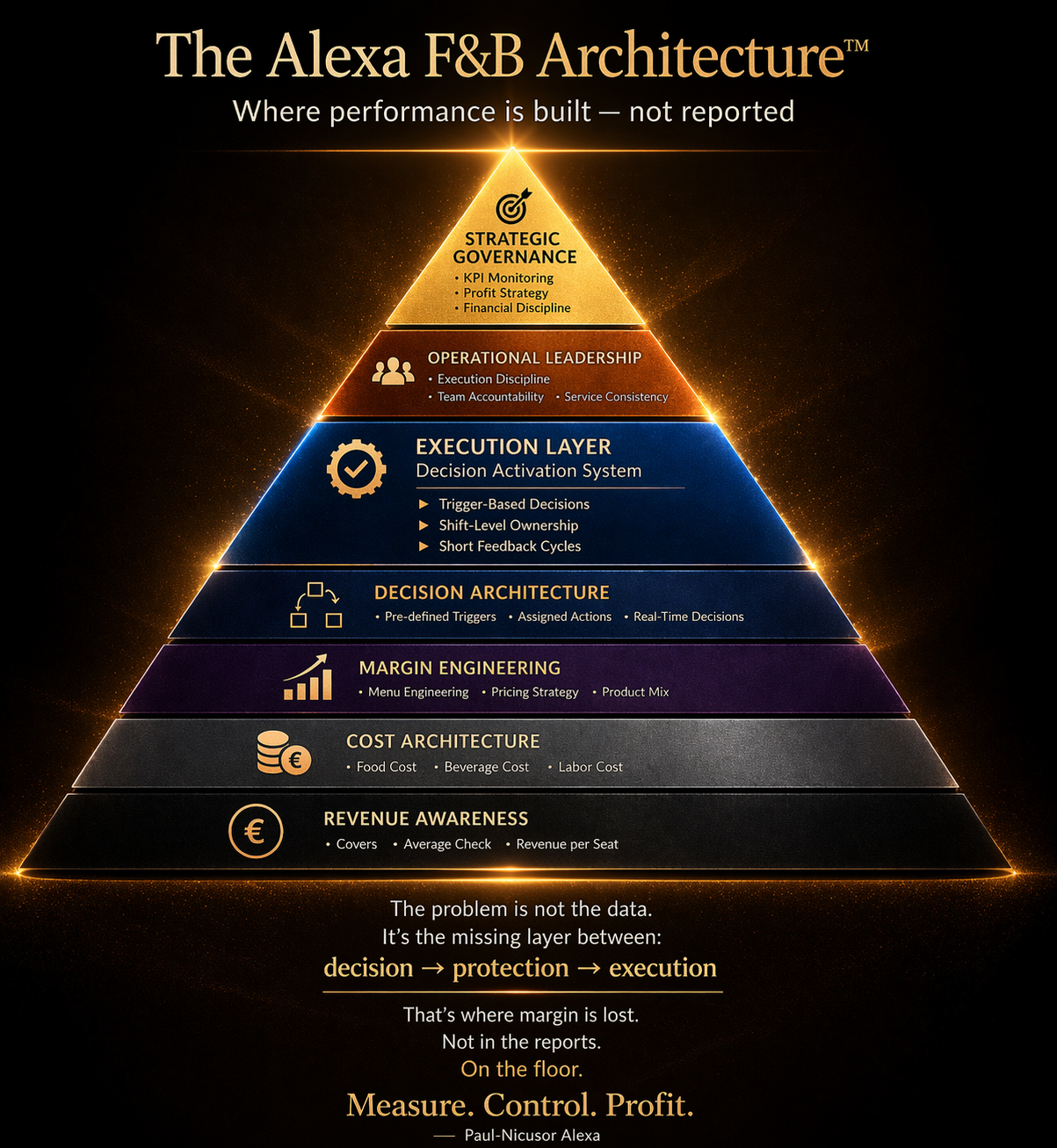
The Alexa F&B Architecture™
An integrated view of revenue, costs, margins and the operating decisions that connect them.
Explore the F&B application →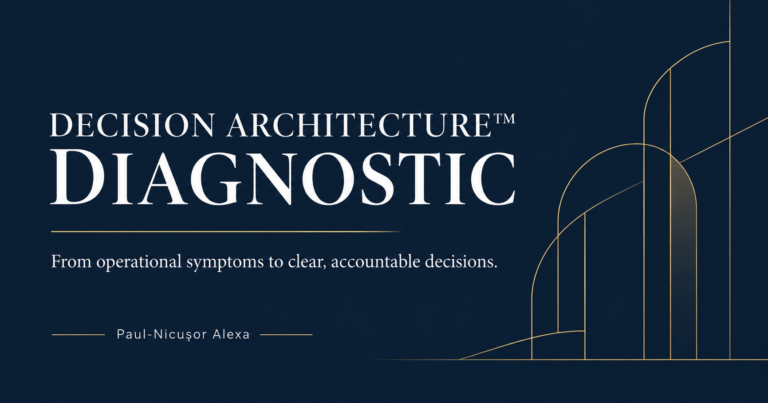
Where does the decision stall?
A diagnostic perspective on unclear ownership, limited authority and dependence on key individuals.
Understand the Diagnostic →What keeps returning
in your operation?
Tell me what happens, how often it happens and what it costs your team to resolve it. We can begin with a written exchange.
Describe your situation →info@alexasconsulting.com · Scope and next steps agreed before any engagement.