The Alexa F&B Architecture™
A strategic framework designed to transform Food & Beverage operations into structured profit centers
Measure. Control. Profit.
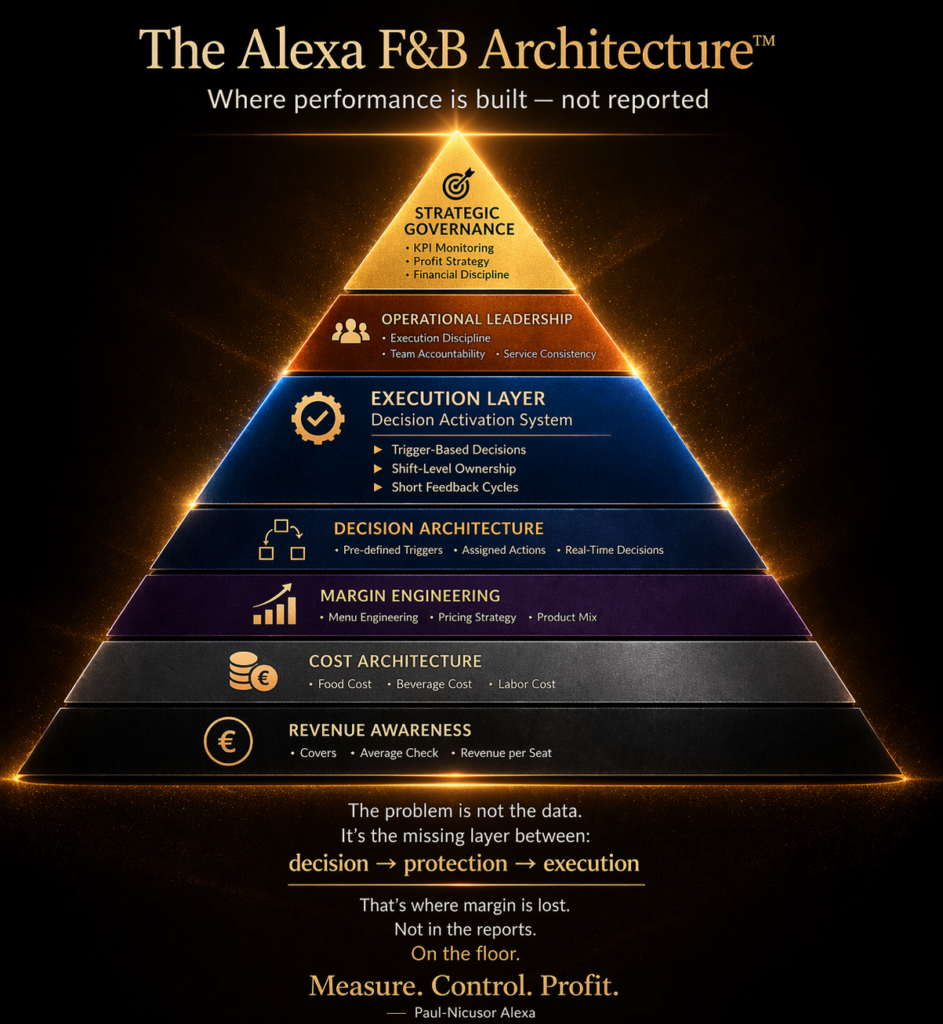
Structure generates margin. Decision architecture protects it.
The Alexa F&B Architecture™ is a proprietary framework developed by Paul-Nicusor Alexa.
© 2026 All rights reserved.
Professional Context
With over 20 years of experience in Food & Beverage operations,
I have developed a management approach focused on structured performance and operational discipline.
Throughout my career I have observed a recurring challenge in hospitality: many operations focus primarily on volume, while profitability depends on structure.
Successful Food & Beverage departments are not built only on sales, but on clear cost architecture, disciplined execution and strategic leadership.
This perspective led me to develop The Alexa F&B Architecture™ — a strategic framework designed to transform Food & Beverage operations into structured profit centers.
The framework applies Decision Architecture™ principles to the specific economic and operational realities of Food & Beverage performance, connecting cost structure, margin strategy, decision systems and real-time execution.
See how this framework translates into measurable Food & Beverage performance:
→ Improve F&B profitability in hotel operations
Operational Performance & Cost Governance
In Food & Beverage operations, sustainable profitability does not depend on volume alone, but on structured economic control and disciplined operational governance.
Through KPI-driven management systems, cost architecture design and menu engineering strategies, I support hospitality organizations in strengthening financial performance and operational stability.
Selected performance outcomes include:
- Food Cost stabilized within the 28–32% benchmark range
- Beverage gross margin improved by 4–6% through pricing optimization
- Labor cost aligned within the 33–35% target range
- Contribution per cover strengthened through menu mix engineering
- Operational performance supported through structured KPI reporting and cost governance
These results reflect a management approach based on economic clarity, margin discipline and measurable operational control.
Volume does not create profit.
Structure does.
Strategic Areas of Expertise
My work focuses on structuring Food & Beverage operations as measurable and economically sustainable business units. Through disciplined operational frameworks, cost architecture design and KPI-driven governance, I support hospitality organizations in strengthening financial performance and operational clarity.
Key strategic areas include:
• Cost Architecture & Financial Discipline
Design and control of cost structures to ensure sustainable margins and long-term financial stability.
• Margin Engineering & Pricing Strategy
Optimization of pricing structures, product mix and beverage programs to maximize contribution per cover and overall profitability.
• Decision Architecture & Performance Activation
Transformation of operational frameworks into real-time decision systems.
Definition of triggers, decision logic, ownership and action protocols that activate performance during service — not after.
Ensures that pricing, mix and cost structures are executed with discipline, turning volume into controlled margin.
• Performance Control & Real-Time Execution
Active floor management and decision ownership during service.
Translation of KPIs into immediate actions through continuous monitoring of service dynamics, protecting timing, consistency and margin under pressure.
• Decision Ownership & Accountability Systems
Clear definition of decision rights, responsibilities and escalation paths.
Establishes who decides, when, and based on which triggers — eliminating ambiguity and ensuring consistent execution across shifts.
• Operational Performance & KPI Governance
Implementation of structured KPI governance and reporting systems to support operational control and strategic decision-making.
Alignment of KPIs with real-time execution to ensure performance is built during service — not only analyzed after.
• Menu Engineering & Contribution Analysis
Analysis of menu mix and contribution per cover to improve profitability at product level and guide strategic pricing decisions.
• Revenue Conversion & Commercial Performance
Structured approach to converting guest volume into measurable profit.
Optimization of upselling, sales mix and beverage attach rate to maximize revenue per guest and margin per service.
• Behavioral Execution & Team Performance
Alignment of team behavior with operational strategy through clear guidance, pre-defined decision frameworks and in-service direction.
Reduces reactive compensation under pressure and ensures consistent execution across shifts.
• Hospitality Operational Strategy
Alignment between operational structure, service standards and financial performance to ensure scalable and repeatable results.
Most Food & Beverage operations don’t have a revenue problem.
They have a structure problem.
Volume is already there.
What’s missing is control, alignment and contribution.
If you want to understand how to improve F&B profitability in real operations:
→ Explore how to improve F&B profitability How to increase F&B profitability in high-volume hotels
The 7 Strategic Layers of the Alexa F&B Architecture
The 7 Strategic Layers of the Alexa F&B Architecture™
The Alexa F&B Architecture™ is structured around seven integrated operational layers designed to transform Food & Beverage departments into controlled profit engines.
Each layer represents a management discipline that contributes to sustainable profitability, operational stability and real-time performance control.
This is not a theoretical model.
It is a practical system designed to translate strategy into execution — during service.
1️⃣ Revenue Awareness
Revenue Awareness represents the foundation of the model.
It focuses on understanding the relationship between:
- covers
- average check
- revenue per seat
Without revenue awareness, operational decisions remain disconnected from financial outcomes.
2️⃣ Cost Architecture
Cost Architecture focuses on the structural control of the three primary cost drivers:
- food cost
- beverage cost
- labor cost
It ensures that the financial structure of the operation remains sustainable and aligned with revenue generation.
3️⃣ Margin Engineering
Margin Engineering focuses on optimizing profitability through:
- menu engineering
- pricing strategy
- product mix control
It ensures that revenue is not only generated, but converted into contribution and margin.
4️⃣ Revenue Conversion & Commercial Performance
This layer focuses on transforming guest volume into measurable profit.
It includes:
- structured upselling strategies
- beverage attach rate optimization
- sales mix control
It ensures that every guest interaction contributes not only to revenue, but to margin generation.
5️⃣ Decision Architecture & Performance Activation
This layer transforms operational frameworks into real-time decision systems.
It defines:
- triggers
- decision logic
- ownership
- action protocols
So that performance is activated during service — not analyzed after.
It removes ambiguity and ensures that pricing, mix and cost structures are executed with discipline under pressure.
6️⃣ Real-Time Execution & Operational Leadership
This layer focuses on active performance control during service.
It includes:
- floor presence and real-time decision-making
- team guidance under pressure
- execution discipline
- service consistency
It ensures that strategy is not only defined, but actively controlled in real time, protecting timing, consistency and margin.
7️⃣ Strategic Governance & Performance Control
This represents the highest strategic level of the framework.
It includes:
- KPI governance
- performance monitoring
- profit strategy alignment
- financial discipline
It ensures that all operational layers remain aligned with long-term profitability objectives.
From Operations to Profit Engine
The Alexa F&B Architecture™ is not a static model.
It is a performance system.
Designed through more than two decades of operational experience in high-volume Food & Beverage environments, it provides a structured approach to turning operations into predictable and scalable profit engines.
Where Performance Is Built
Performance is not managed through reports.
It is built and controlled during service.