
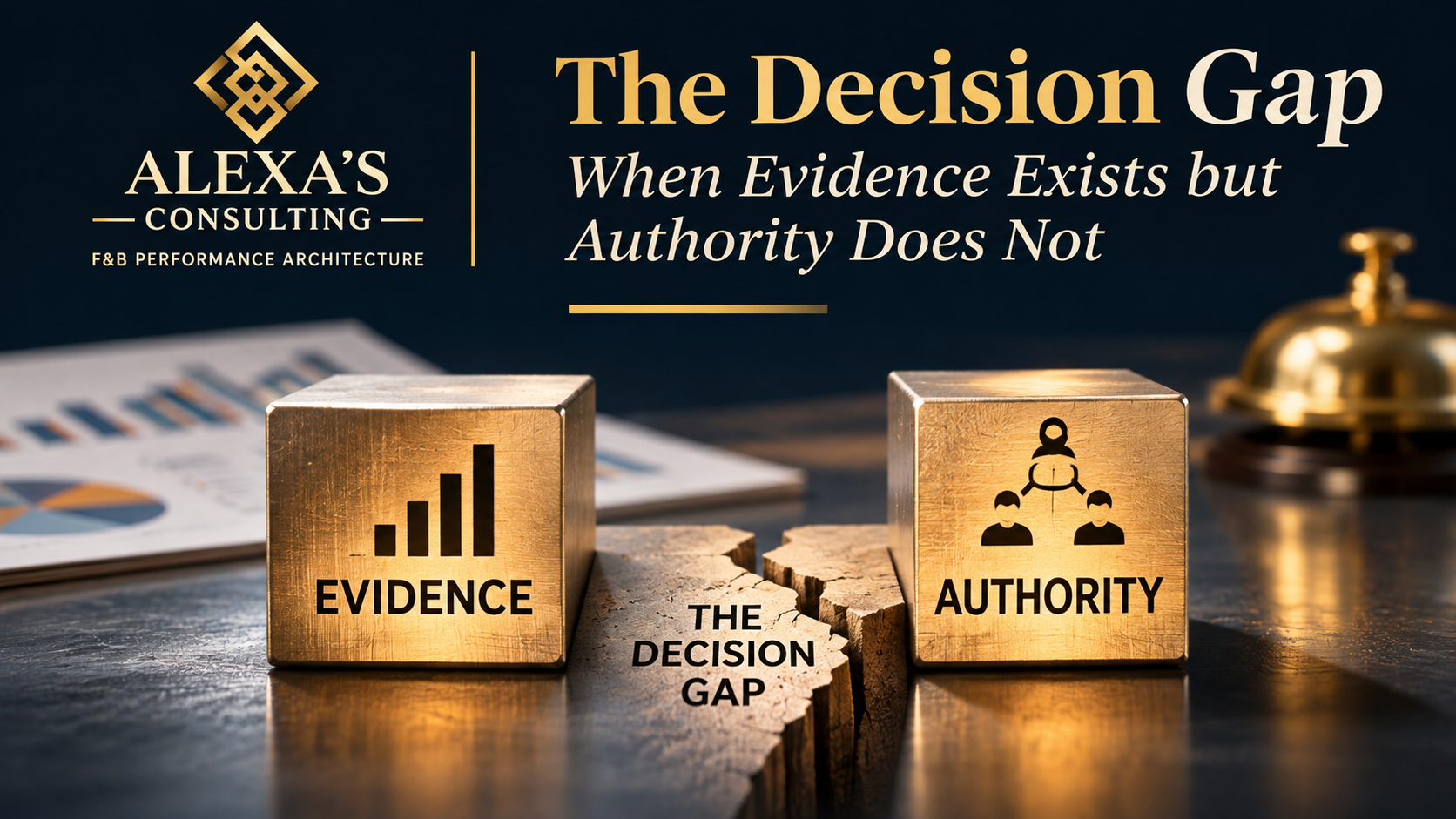
Why organisations recognise operational problems but fail to correct them.
Organisations rarely fail because they have no information. They often fail because information does not become an authorised, timely and verifiable decision.
A performance dashboard identifies a deviation. A department head recognises a recurring inefficiency. Frontline employees report a constraint. Financial indicators suggest that corrective action is necessary.
The organisation has evidence. Yet the problem persists.
The question is no longer whether the problem is visible. It is whether the organisation has designed the conditions required to act on what it knows.
1. Visibility Is Not Decision Capability
Management systems have become increasingly sophisticated at measuring performance. Revenue, productivity, labour efficiency, profitability, service quality and operational risk can be monitored through increasingly detailed reporting structures.
But measurement and intervention are fundamentally different organisational capabilities.
A dashboard can reveal a deviation without establishing who has the authority to intervene, which conditions make intervention necessary, what evidence justifies action, when escalation becomes mandatory or how the result will be verified.
When these responsibilities remain ambiguous, organisations may possess extensive operational visibility without the corresponding ability to respond.
Better information does not automatically create better governance.
2. The Hidden Cost of Decision Ambiguity
Consider a multi-department organisation experiencing a recurring operational bottleneck. The problem is known. Employees have reported it. Managers have discussed it. Financial reporting confirms an associated performance deviation.
Yet responsibility for the corrective decision remains distributed across functions. Operations identifies the issue. Finance assesses its economic implications. Human Resources considers staffing constraints. Senior management retains final approval.
Each function may be performing its assigned responsibilities correctly. Nevertheless, the corrective action remains unresolved.
The problem is not necessarily a lack of competence. It may be a structural gap between identifying an issue and authorising its resolution.
That gap can generate repeated escalation, delayed intervention, duplicated analysis and dependence on individual managers. Temporary workarounds may gradually become normal operating practices.
The accumulated cost is not always visible as a separate financial line item. It may nevertheless affect productivity, service consistency, organisational responsiveness and management capacity.
3. Accountability Without Authority Is an Incomplete System
Organisations frequently assign responsibility for performance outcomes. A manager may be accountable for labour productivity, customer experience or departmental profitability.
But accountability becomes structurally weak when the same manager lacks clearly defined authority to intervene in the underlying causes of poor performance.
Performance accountability identifies who is responsible for results. Decision authority determines who is empowered to change the conditions producing those results.
The two must be aligned. Otherwise, organisations risk evaluating managers against outcomes they cannot meaningfully influence.
The answer is not unrestricted decentralisation. It is the explicit design of decision rights, intervention thresholds and escalation mechanisms proportionate to operational risk.
4. From Evidence to Verified Outcomes
Decision Architecture™ examines this challenge through a structured sequence:
Evidence → Finding → Human Review → Decision Card → Outcome Verification
Evidence establishes what can be documented. Finding identifies the organisational condition supported by that evidence. Human Review evaluates whether the finding is defensible, including limitations and alternative interpretations. Decision Card structures the proposed intervention, relevant authority and conditions for action. Outcome Verification examines whether the intervention produced the intended result and whether further correction is necessary.
This sequence distinguishes identifying a problem from justifying a decision and verifying its consequences.
Human Review does not guarantee the certainty of an outcome. It assesses whether a finding is sufficiently defensible to support the next stage of decision-making.
Decision Architecture™ remains a developing methodology. Its conceptual and diagnostic structures are not presented as having completed empirical validation.
5. The Executive Test
An organisation seeking to evaluate its decision capability should ask three questions:
Who has the authority to intervene?
Not merely who reports the problem, but who can authorise a corrective change.
What evidence activates the decision?
Not simply which indicators are monitored, but which conditions require assessment, escalation or intervention.
How is the outcome verified before a change becomes standard practice?
Not merely whether action was taken, but whether its consequences were evaluated against explicit expectations.
These questions become especially important when operational performance depends on the presence, judgement or personal intervention of specific individuals.
A resilient organisation should not require the constant availability of one exceptional manager to function effectively. Its decision structures should remain intelligible and operational when that individual is absent.
6. The Strategic Implication
Digital transformation can improve the speed and availability of information. Performance management can strengthen visibility. Leadership development can improve judgement. But none of these necessarily resolves ambiguity in organisational decision rights.
An organisation may become more informed without becoming more capable of acting.
The executive challenge is therefore not only to improve measurement or accelerate reporting. It is to design the organisational conditions through which evidence can lead to accountable intervention and verified learning.
The ultimate measure of a management system is not how quickly it detects a problem, but whether it enables the organisation to address that problem responsibly and learn from the result.
That is the organisational challenge Decision Architecture™ seeks to investigate.
Paul-Nicușor Alexa
Food & Beverage Director
Founder, Alexa’s Consulting
Developer, Decision Architecture™
Design the System. Drive Performance.
Further exploration
Alexa’s Consulting — Official Website
Decision Architecture™ Diagnostic
Decision Architecture™ on Substack