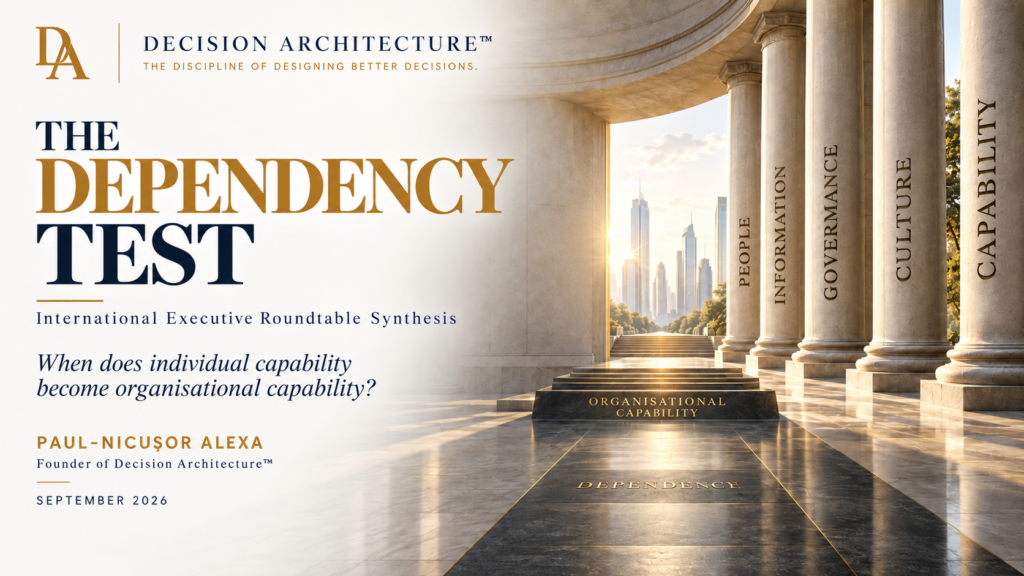
INTERNATIONAL EXECUTIVE ROUNDTABLE SYNTHESIS
When does individual capability become organisational capability?
Paul-Nicușor Alexa
Founder of Decision Architecture™
September 2026
EXECUTIVE SUMMARY
High performance does not necessarily prove that an organisation has a strong operating system.
In many organisations, successful outcomes are repeatedly protected by capable individuals who recognise problems early, resolve ambiguity, connect functions, compensate for weak processes and intervene before performance deteriorates.
The organisation appears capable.
But an important question remains:
“What evidence would show that performance is being produced by the organisation’s decision system rather than being rescued by one capable individual?”
This question formed the basis of an international professional discussion initiated on LinkedIn around what I call the Dependency Test.
The starting question was deliberately simple:
“Would the same outcome still occur if that person were absent?”
The discussion showed that absence is an important test, but not a sufficient one.
Organisational capability becomes more credible when comparable decision quality can be reproduced by others; when responsibility is accompanied by authority; when cross-functional handoffs remain effective without personal orchestration; when significant decisions and exceptions are traceable; and when learning is retained by the organisation rather than remaining embedded in the individual who solved the problem.
The central conclusion is therefore broader than continuity during absence:
“The deeper Dependency Test asks whether the organisation has absorbed enough capability to reproduce sound decisions without requiring the same individual to repeatedly restore the system.”
- THE ATTRIBUTION PROBLEM
Organisations commonly evaluate performance through outcomes.
Revenue increased.
Costs remained controlled.
The opening succeeded.
The guest problem was resolved.
The disruption was contained.
The operation continued.
But an outcome alone does not tell us what produced it.
The same successful result may arise from two fundamentally different organisational conditions.
In the first, the organisation possesses functioning decision mechanisms. Relevant signals are recognised, ownership is clear, authority exists, action follows, escalation occurs when necessary and learning returns to the system.
In the second, an experienced individual notices what the system failed to notice and personally reconnects the missing pieces.
Both situations can produce good performance.
Only the first provides strong evidence that capability resides in the organisation rather than primarily in the individual.
The Dependency Test therefore addresses a fundamental attribution question:
“Was performance produced by the system, or was the system rescued by an individual?”
- FINDING ONE
ABSENCE IS THE FIRST TEST, NOT THE FINAL TEST
The most immediate way to expose dependency is to ask what happens when the person on whom the organisation appears to rely is no longer present.
Would the same outcome occur?
This is a useful starting point, but temporary continuity does not necessarily prove independence.
Another capable person may compensate.
Important decisions may be postponed.
Existing routines may temporarily carry the operation.
The consequences of weaker decisions may not yet be visible.
The organisation can therefore survive an absence while remaining structurally dependent.
“Surviving the absence of a key individual is not the same as eliminating dependency on that individual.”
The test must go further.
- FINDING TWO
REPRODUCIBILITY IS STRONGER EVIDENCE THAN ISOLATED SUCCESS
A single successful outcome is weak evidence of systemic capability.
Stronger evidence exists when comparable decision quality can be reproduced:
across different people,
across shifts,
across teams,
across locations,
and under changing operating conditions.
This does not mean that every person must make exactly the same decision.
Organisational capability is not behavioural uniformity.
The relevant question is whether the organisation contains enough shared logic, authority, information and learning for competent people to reach decisions of comparable quality without depending on one individual’s memory, relationships or personal judgement.
The Dependency Test therefore asks:
“Can the organisation reproduce decision quality, not merely reproduce procedure?”
Procedure can be documented.
Judgement must be transferred, supported and governed.
- FINDING THREE
DEPENDENCY OFTEN HIDES IN THE HANDOFFS
A particularly important theme emerging from the discussion concerns the spaces between functions.
An organisation may have strong departments and still possess a weak operating system.
Operations may perform well.
Food & Beverage may perform well.
Finance may perform well.
Procurement may perform well.
Guest Experience may perform well.
Yet one senior individual may still be required to continuously connect those functions.
This makes the handoff a critical unit of analysis.
When responsibility moves from one team to another:
Who owns the next action?
What information moves with it?
Does the receiving function have sufficient authority?
Is the transfer understood by both sides?
How is completion confirmed?
Where does accountability sit when work crosses organisational boundaries?
This produces an important extension of the Dependency Test:
“The system must work not only within roles, but between roles.”
When one person continually interprets, translates, coordinates and reconnects functions, apparently strong departmental performance may still conceal systemic dependency.
- FINDING FOUR
COMPETENCE WITHOUT AUTHORITY DOES NOT REMOVE DEPENDENCY
A team may understand exactly what should happen and still remain dependent on a senior leader.
The reason is simple:
Knowledge and authority are not the same thing.
A manager may recognise the problem.
The manager may know the appropriate response.
The manager may even be accountable for the outcome.
But if action still requires approval from above, the dependency remains embedded in the structure.
The question therefore cannot stop at:
“Do people know what to do?”
It must also ask:
“Do they possess the standing authority to act within clearly defined boundaries?”
Responsibility without authority creates the appearance of delegation without the reality of decision ownership.
A useful principle follows:
“Capability has not been fully transferred when exercising that capability still requires permission from the person from whom the organisation is supposedly becoming independent.”
- FINDING FIVE
DOCUMENTATION IS NOT ORGANISATIONAL CAPABILITY
Organisations often possess sophisticated operating materials:
SOPs,
playbooks,
manuals,
frameworks,
training programmes,
checklists,
standards.
These can be valuable.
But their existence does not demonstrate that they produced the outcome.
A framework may be present while the real decision continues to be generated through informal relationships and personal judgement.
The relevant evidence therefore cannot simply be:
Framework present → Successful outcome
A stronger chain is:
Framework → Decision → Authority → Action → Outcome → Learning
Did the operating logic influence the decision?
Was ownership clear?
Did the person responsible possess authority?
Was the decision actually executed?
Was the outcome observed?
Did anything return to improve future decisions?
Without this chain, an organisation may possess documentation without possessing the capability that documentation was intended to create.
Distribution is not adoption.
And adoption alone is not capability.
- FINDING SIX
TRACEABILITY HELPS DISTINGUISH SYSTEM PERFORMANCE FROM INVISIBLE RESCUE
Highly capable individuals often prevent failures before those failures become visible.
This creates a paradox.
The better they become at rescuing the operation, the easier it becomes for the organisation to believe that the system itself is working.
The visible evidence is the successful outcome.
The invisible evidence is the intervention that protected it.
For this reason, the Dependency Test requires a degree of decision traceability.
For a meaningful exception, can the organisation reconstruct:
Signal → Recognition → Decision → Authority → Action → Escalation → Outcome → Feedback
Who recognised the issue?
Who owned the decision?
What authority permitted the response?
Was escalation required?
Was the action executed?
What happened afterward?
What was learned?
A positive result without this trace tells us relatively little about the mechanism that created the result.
“Decision traceability helps distinguish organisational capability from successful rescue.”
- FINDING SEVEN
LEARNING MUST REMAIN WHEN THE INDIVIDUAL LEAVES
The strongest form of dependency may only become visible over time.
A highly capable manager can resolve hundreds of operational problems.
But the more important question is:
What happens to those solutions?
Do they remain inside personal experience?
Or do they change how the organisation recognises, decides and responds the next time?
When the individual leaves, what remains?
Decision criteria?
Can the organisation continue to perform when the key individual is not present?
Authority boundaries?
Escalation rules?
Shared judgement?
Patterns learned from previous exceptions?
Evidence about what worked and what did not?
If these remain, individual capability has begun to become organisational capability.
If they disappear with the individual, the organisation may have benefited from expertise without ever absorbing it.
- A DEEPER DEPENDENCY TEST
The discussion suggests that dependency should be examined across several dimensions rather than through absence alone.
ABSENCE
REPRODUCIBILITY
Can others generate comparable decision quality under similar conditions?
AUTHORITY TRANSFER
Can those people act within defined boundaries without unnecessary escalation to the previous decision centre?
HANDOFF RESILIENCE
Can responsibility, information and accountability move between functions without one individual continually reconnecting the organisation?
TRACEABILITY
Can significant decisions and exceptions be reconstructed well enough to understand what actually produced the outcome?
LEARNING RETENTION
Does experience improve the organisation’s future decision capability, or does learning remain primarily with the individual?
Taken together, these dimensions provide considerably stronger evidence of organisational capability than the observation that an operation continued while one person was absent.
- FROM INDIVIDUAL CAPABILITY TO ORGANISATIONAL CAPABILITY
The Roundtable highlighted an important distinction.
INDIVIDUAL CAPABILITY
A capable individual can:
recognise weak signals;
interpret ambiguity;
connect people and functions;
navigate informal relationships;
resolve exceptions;
protect outcomes;
compensate for weaknesses elsewhere in the system.
ORGANISATIONAL CAPABILITY
A capable organisation can:
recognise decision-worthy signals;
establish clear ownership;
provide appropriate authority;
coordinate across organisational boundaries;
execute without unnecessary intervention;
escalate intelligently;
preserve decision traceability;
convert experience into future learning.
The transition between the two does not occur simply because knowledge has been documented.
It occurs when the organisation can exercise the capability independently.
- ROUNDTABLE CONCLUSION
The discussion began with a simple question:
“Would the same outcome still occur if the capable individual were absent?”
The Roundtable suggests that the stronger question is:
“Can the organisation reproduce comparable decision quality across people, functions and situations without depending on one individual’s judgement, relationships or repeated intervention?”
Successful outcomes alone cannot answer that question.
Stronger evidence exists when decision quality is reproducible, authority accompanies responsibility, handoffs operate without continuous personal orchestration, important decisions remain traceable, exceptions generate organisational learning and capability survives beyond the individual who originally carried it.
The Dependency Test therefore moves beyond operational continuity.
It examines whether capability has actually transferred:
FROM THE PERSON INTO THE ORGANISATION.
An organisation becomes less dependent not when the exceptional individual stops being valuable, but when the system no longer requires that individual to repeatedly compensate for what the organisation itself cannot yet do.
- CONNECTION WITH DECISION ARCHITECTURE™
Several themes that emerged from the Roundtable intersect with questions addressed by Decision Architecture™:
Decision Ownership
Authority Boundaries
Decision Triggers
Execution
Escalation
Cross-Functional Coordination
Traceability
Feedback
Organisational Learning
The Roundtable should not be interpreted as a formal validation of Decision Architecture™.
It is better understood as an independent professional discussion that helps sharpen a broader operational question:
“What would we need to observe inside an organisation before claiming that its performance is being produced by a functioning decision system?”
Decision Architecture™ approaches this question by examining the architecture through which organisations convert signals into authorised, executable and learnable decisions.
A simplified decision chain can be expressed as:
Signal → Trigger → Decision Owner → Authority → Action → Escalation → Outcome → Feedback → Learning → Adaptation
The relevance of the Dependency Test becomes particularly visible when one or more of these elements cannot function without repeated intervention from a specific individual.
That creates the bridge from discussion to diagnosis.
Because once dependency can be described conceptually, the next challenge is to determine:
Where does it exist inside a real organisation?
Which decisions depend excessively on particular individuals?
Where is authority misaligned with responsibility?
Where do cross-functional handoffs fail?
Where is escalation replacing legitimate decision ownership?
Where is intervention repeatedly required to protect performance?
Where is learning being lost?
Those are no longer only editorial questions.
They are diagnostic questions.
CLOSING PROPOSITION
“Performance can be rescued by individuals.
Capability must be carried by the organisation.”
The Dependency Test helps distinguish between the two.
METHODOLOGICAL NOTE
This publication synthesises themes emerging from an international professional discussion initiated by Paul-Nicușor Alexa on LinkedIn in September 2026.
The Roundtable was designed as an exploratory professional exchange rather than as formal academic or empirical research.
Contributions reflected participants’ professional experience, interpretation and operating perspectives.
The synthesis identifies recurring themes, differences in emphasis and practical implications emerging from the discussion. It does not claim statistical representativeness, scientific validation or formal empirical confirmation of Decision Architecture™.
Unless explicitly quoted and attributed, the conclusions presented in this publication represent the author’s synthesis and interpretation of the discussion rather than the individual position of any single participant.
The purpose of the synthesis is not to claim consensus, but to make visible the questions, patterns and operational implications that emerged when the Dependency Test was examined through different professional perspectives.
ACKNOWLEDGEMENTS
My sincere thanks to the professionals who contributed their experience, questions, challenges and perspectives to this discussion.
The value of the Roundtable came not from agreement, but from examining the same question through different operational, leadership and organisational lenses.
The contributions helped move the Dependency Test beyond a simple question about individual absence toward a deeper examination of reproducibility, authority, cross-functional handoffs, traceability and organisational learning.
I am grateful to everyone who contributed to making that distinction clearer.
PUBLICATION DETAILS
Title:
The Dependency Test — International Executive Roundtable Synthesis
Subtitle:
When does individual capability become organisational capability?
Author:
Paul-Nicușor Alexa
Framework:
Decision Architecture™
Publication Type:
Executive Roundtable Synthesis
Edition:
First Edition
Publication Date:
September 2026
Origin of Discussion:
International professional discussion initiated on LinkedIn
Website:
alexasconsulting.com
DOWNLOAD THE PDF EDITION
A downloadable PDF edition of The Dependency Test — International Executive Roundtable Synthesis is available for readers who prefer to retain, share or review the publication offline.
The Dependency Test raises a practical question:
“Where is an organisation still dependent on individuals to compensate for weaknesses in its decision system?”
Decision Architecture™ examines how organisations recognise decision-worthy signals, establish ownership, define authority, execute decisions, escalate exceptions and convert outcomes into organisational learning.
© 2026 Paul-Nicușor Alexa.
Decision Architecture™.
All rights reserved.