Operational Visibility Case Study | From Volume to Visibility™
How Operational Architecture
Creates Better Decisions
Before Better Results
CASE STUDY 02
INTRODUCTION
Not every performance challenge is a revenue challenge.
Some operations already generate demand.
Guests arrive.
Tables remain occupied.
Service continues.
From the outside, performance appears healthy.
But volume and performance are not the same thing.
Activity can coexist with complexity.
Operational performance does not improve through activity alone. It improves when information becomes visible enough to enable better decisions. Research from McKinsey & Company has repeatedly highlighted the connection between decision quality, execution and measurable outcomes.
Growth can coexist with reduced visibility.
This case documents the early phase of an operational redesign inside an established restaurant environment operating at significant scale.
This case documents the early phase of an operational redesign inside an established restaurant environment operating at significant scale.
The objective was not immediate growth.
The objective was increasing operational visibility.
Because operational visibility improves decision quality.
And better decisions improve performance.
The objective was increasing operational visibility.
Because visibility improves decisions.
And better decisions improve performance.
THE CONTEXT
Business Type
Family-Owned Restaurant
Established
Since 1909
Operating Model
Year-Round Operation
Annual Revenue
Approx. €1.3M
Annual Volume
Approx. 40,000 Covers
Demand Concentration
Approx. 26,000 covers generated within a 100-day peak season
Environment
High-Volume Restaurant Operation
Peak Season Structure
10 Team Members in Service
10 Team Members in Kitchen
Leadership Structure
Two brothers directly involved in daily operations.
Executive kitchen leadership.
Marketing and commercial direction.
Next-generation participation across operations and service.
Operational Context
Multiple family members contribute directly to execution and decision-making.
This was not a turnaround situation.
Demand already existed.
Revenue already existed.
Volume already existed.
The challenge was different.
How do you improve decision quality without disrupting identity?
Because mature operations rarely struggle from lack of activity.
More often, they struggle from limited visibility inside complexity.
The objective was not changing what made the business successful.
The objective was making performance easier to observe, discuss and repeat.
THE QUESTION
How do you improve performance before changing revenue?
Not by increasing pressure.
By improving the quality of decisions.
Because stronger performance is often built before it becomes measurable.
The operation did not require more demand.
Demand already existed.
The operation did not require more activity.
Activity already existed.
The question was different.
How do you increase visibility without reducing speed?
How do you improve consistency without removing identity?
How do you create stronger decisions before stronger results?
The objective was not transformation.
It was greater operational clarity.
Because operational visibility improves conversations.
Conversations improve decisions.
And decisions improve outcomes.
Operational visibility became the operating principle for improving alignment, execution consistency and decision quality.
THE APPROACH
The objective was not increasing activity.
The objective was increasing the quality of decisions inside an already active operation.
The intervention focused on four operating areas.
01 | MENU ARCHITECTURE
The menu was observed not only as a sales tool.
But as an operating system.
Questions explored:
Which dishes generate contribution?
Which dishes generate complexity?
Which dishes strengthen identity?
Which dishes consume execution capacity?
The objective was not reducing choice.
It was improving clarity.
02 | DECISION VISIBILITY
Operational conversations gradually moved from volume indicators toward performance indicators.
Examples:
Revenue → Contribution
Busy Service → Quality of Execution
More Covers → Stronger Output
The objective was making performance easier to observe.
Because volume explains movement.
Visibility explains performance.
03 | EXECUTION DISCIPLINE
Focus areas included:
Pre-service alignment
Service standards
Ownership of details
Operational consistency
Performance rarely scales through effort.
It scales through repeatability.
04 | PERFORMANCE GOVERNANCE
Execution was supported through a more structured reading of operations.
Attention shifted toward:
Priorities
Visibility
Ownership
Operating signals
The objective was not creating more control.
It was reducing unnecessary variability.
WHAT CHANGED
This case is intentionally documented before final financial outcomes.
Because operational improvements often become visible before they become measurable.
At this stage, the most relevant observations were behavioral.
Greater Menu Clarity
Conversations became less centered on preferences and more centered on operating logic.
Questions started changing.
Not:
What do we sell more?
But:
What creates stronger contribution with repeatable execution?
Stronger Decision Consistency
Decisions became less dependent on escalation.
More situations started being solved inside existing operating boundaries.
The objective was not autonomy.
It was alignment.
Improved Execution Visibility
Operational discussions became more structured.
Attention moved beyond:
Service completed
Tables served
Daily volume
Toward:
Quality of execution
Decision patterns
Operating signals
Better Performance Awareness
Performance stopped being observed only through outcomes.
More attention shifted toward:
How results are created.
Because results are delayed.
Execution is immediate.
EARLY CONCLUSION
No final conclusions are presented yet.
This case documents an operating phase rather than a completed transformation.
Because operational improvements often become visible before they become measurable.
At this stage, the most relevant observations were behavioral.
Conversations became more structured.
Decisions became more consistent.
Execution became easier to observe.
The operation did not become stronger because it became busier.
It became clearer.
And clarity improves decisions.
Early observations suggest that better operational visibility may improve decision quality before improving financial outcomes.
Because performance rarely appears suddenly.
More often, it becomes visible progressively.
First in conversations.
Then in decisions.
Then in results.
FINAL REFLECTION
This case does not demonstrate a completed transformation.
It documents an operating belief.
Performance rarely improves because businesses become busier.
Performance improves when decisions become clearer.
In high-volume environments:
Activity can hide inefficiencies.
Revenue can hide complexity.
Execution can hide inconsistency.
That is why operational visibility matters.
Because what becomes visible can be discussed.
What is discussed can be improved.
What is improved repeatedly can become standard.
Perhaps sustainable performance is not created when results appear.
It is created when decisions become repeatable.
Because better operations rarely begin with bigger numbers.
They begin with greater clarity.
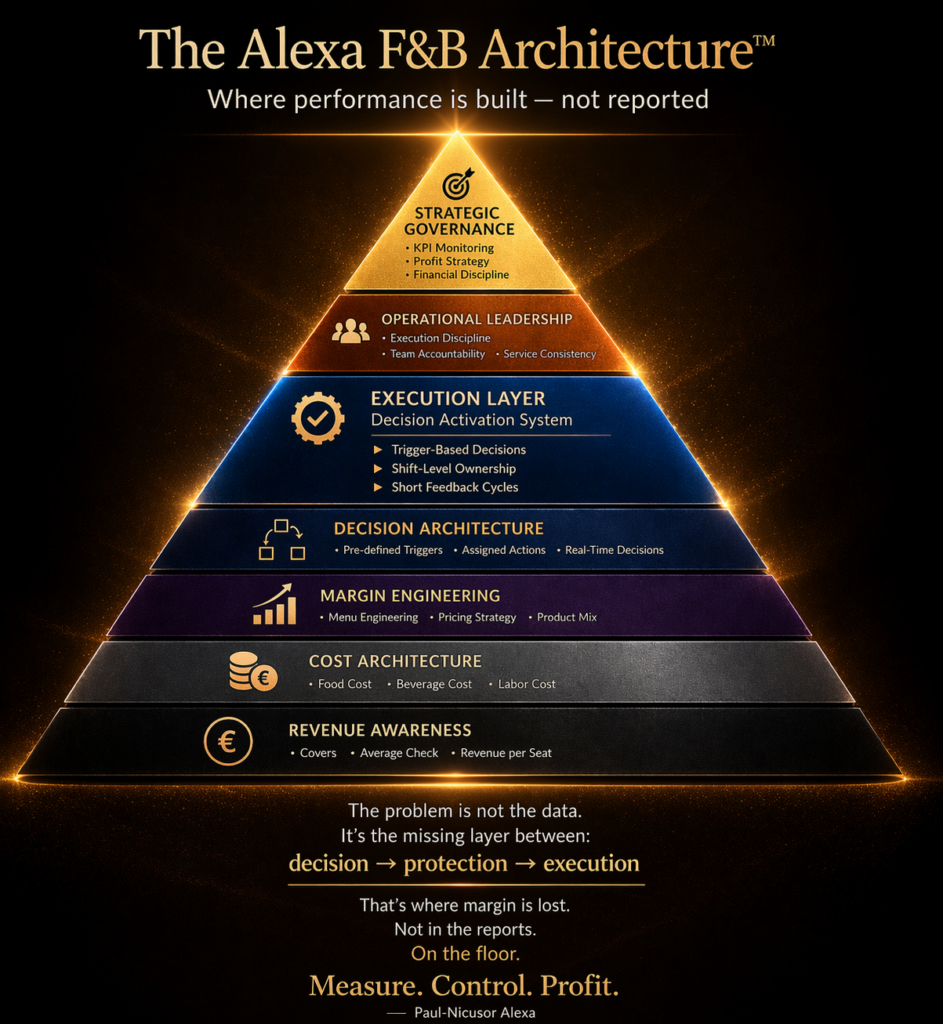
THE ALEXA F&B PERFORMANCE ARCHITECTURE™
Measure. Control. Profit.
Performance is rarely the result of isolated decisions.
It is usually the result of repeated operating choices.
The Alexa F&B Performance Architecture™ was developed to increase visibility before complexity becomes cost.
To improve decisions before performance deteriorates.
And to transform execution into measurable contribution.
Because stronger operations are not built by working harder.
They are built by making better decisions repeatedly.
Request a Food & Beverage Performance Review™
Private • Structured • Data-Informed